
“Imagination and fiction make up more than three quarters of our real life.” — Simone Weil
“Everything is created twice, first in the mind and then in reality.” — Robin Sharma
“I am an old man and have known a great many troubles, but most of them never happened.” — Mark Twain
“We suffer more in imagination than in reality.” — Seneca
“If you spend too much time thinking about a thing, you’ll never get it done.” — Bruce Lee
“Did you ever stop to think, and forget to start again?” — A.A. Milne
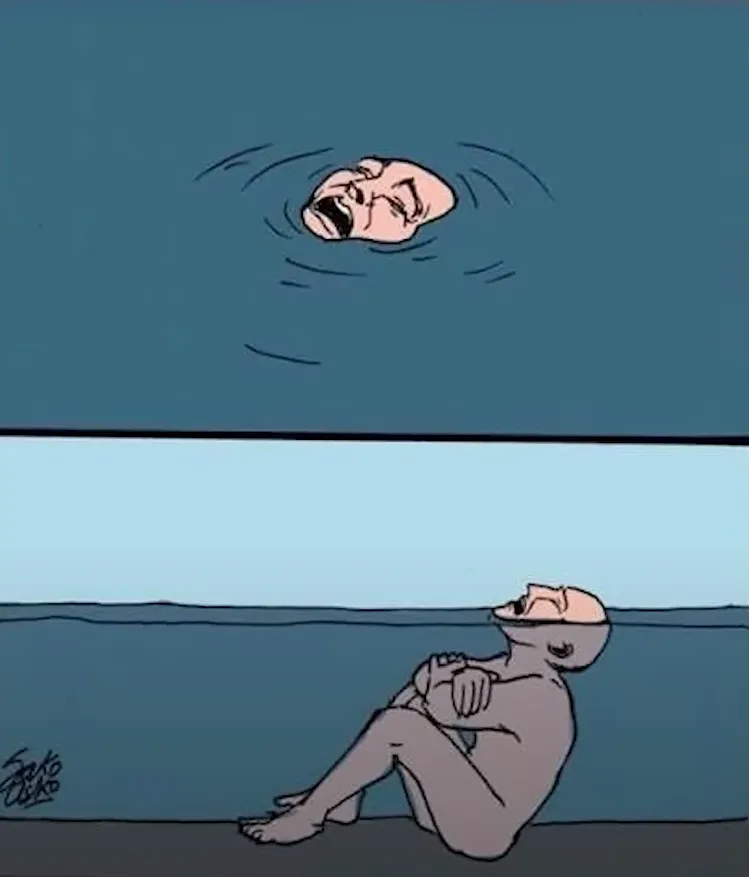
= 想太多 = 過度延伸 = 對號入座
The primary cause of unhappiness is never the situation but your thoughts about it.
人最大的限制是自己的想像力 — 折磨我們的恐懼,通常都是來自對於事情的「想像」,而不是事情「本身」;很多時候,我們只是被自己的一些想法「綑綁」住而已。
唐代禪宗六祖惠能大師所作偈(ㄐㄧˋ)語「菩提本無樹,明鏡亦非台;本來無一物,何處惹塵埃?」,意指佛性(菩提)原本就不是什麼樹,清淨的心性(明鏡)也根本不是一個可以被安置的台座,強調「自性清淨,本來空寂」,沒有實體,因此無從被煩惱(塵埃)所附著,是人心的終極開悟境界。
另一句:「應無所住,而生其心。」—《金剛經》
- 「無所住」:身在紅塵,但不受紅塵困擾。
- 「生其心」:出入紅塵,還能救濟紅塵中的眾生。
Sometimes the smallest things take up the most room in your heart.
有時候,最小的東西,卻在心中佔了最大的位置。
- We often worry a lot in the head throughout our life time, but most of the things that we internally panic about never actually happened.
- Usually our fears/worries are based on “what might happen”, not “what is actually happening right now”
- Try to remind yourself: “I am safe right now.”
Understand the difference between imagination and rumination
Turtles all the way down — 你永遠找不到問題真正的答案,只會找到另一個更深層的問題 1
A surefire way to make a bad situation worse is to continue replaying it in your mind. The damage is done. The only thing that matters now is making the best choice given your current position.
You don’t have a thinking problem—you have an action/skill problem: Overthinking breeds indecision, leading to inaction/underact. Accept the consequences, stay true to your values, and move forward.
The Poison Arrow Principle
Imagine someone is struck by a poisoned arrow. A doctor is called to remove the arrow, but the man stops him. “Not so fast! Before you remove it, I want to know who shot me. What town or village does he come from? What kind of wood was his bow made from? Was it a crossbow or a longbow?” While he asks the questions, the poison takes hold and he dies.
Like the man in the story, we occasionally get shot with the poisoned arrows of life. But ruminating too much on the nature of those arrows is unlikely to help.
Put overthinking to bed. With an average of 60,000–80,000 daily thoughts, remember you don’t need to engage with every single one. Breathe, relax, let it pass.
Eckhart Tolle’s 7-step protocol to escape overthinking:
Step 1: Witness Consciousness
Don’t just “be aware” of thoughts - create deliberate distance by labeling them: “Having a thought about failure” instead of “I’m going to fail.”
Step 2: Pattern Interruption
Tolle recommends a specific technique: When caught in rumination, focus on your hands for 30 seconds.
Step 3: The Power of Pause
When negative thoughts arise, wait 90 seconds before responding.
Step 4: The Reality Test
Ask: “Is this thought happening in physical reality right now?”
Not “Is this thought true?” (which keeps you in thought).
Step 5: Body Anchoring
Instead of general “body awareness,” Tolle recommends feeling your inner energy field:
The tingling life-energy inside your hands, feet, and entire body.
This creates what neuroscientists call “embodied cognition” - thinking from your whole nervous system.
Step 6: Radical Acceptance
Don’t just “accept what is” - Tolle teaches saying “yes” to the feeling of resistance itself.
When you feel yourself fighting reality, accept the fighting.
Step 7: Present Moment Anchoring
Rather than trying to “be present,” Tolle suggests focusing on one sense perception completely:
The sound of water, the sensation of breath, the feeling of air on skin.
This creates what he calls “portals to presence” - gateways beyond thinking.
A true transformation begins with a mental shift
Footnotes
-
An expression of the problem of infinite regress ↩