
“Be careful how you are talking to yourself because you are listening.” — Lisa M. Hayes
“Talk to yourself like you talk to someone you love.” — Brené Brown
“The only thing that keeps us from having what we really want is the stories we tell ourselves.” — Tony Robbins
“The most important conversations you’ll ever have are the ones you’ll have with yourself. — You wake up with them, you walk around with them, you go to bed with them, and eventually you act on them.” — [@gogginsCantHurtMe2018]
“The reason I talk to myself is because I’m the only one whose answers I accept.” — George Carlin
= Internal Monologue = Inner Dialogue
The voice in your head is your permanent roommate.
The most powerful word is the one you use to talk to yourself. The most important conversations you have in life are the ones you have with yourself. Make them positive and constructive. Negative self-talk is the biggest enemy. Don’t say something to yourself that you wouldn’t say to someone you love.
On the one hand, don’t say something to yourself that you wouldn’t say to someone else. On the other hand, the way you speak to others is the way you speak to yourself.
Never say, I’ll never…
永遠不要看輕自己。
Distanced Self-Talk
“Third-person self-talk is a way of being empathetic to ourselves.” — Marc Brackett, Permission to Feel: The Power of Emotional Intelligence to Achieve Well-Being and Success
“Whether you think you can, or you think you can’t—you’re both right.” — Henry Ford
“Just when you think it can’t get any worse, it can. And just when you think it can’t get any better, it can.” — Nicholas Spark
If you say you can. Yes, you can!
If you say you can’t. Yes, you’re right!
At any given moment you have the power to say: “This is not how the story is going to end.”
自證預言 = 自我實現預言 = 自我應驗預言 = Self-Fulfilling Prophecy ≈ 心理暗示
Murphy’s Law
Anything that can go wrong will go wrong.
“Doubt kills more dreams than failure ever will.” — Suzy Kassem
Pay close attention to the stories you tell yourself, because stories create your reality.
The quality of your stories impacts the quality of your life.
- If you tell yourself you aren’t capable, you won’t try.
- If you tell yourself you aren’t worthy, you won’t reach for it.
- If you tell yourself you’re a static entity, you won’t attempt to grow.
So often, it’s not the sheer difficulty of achieving something that stops you—it’s the ease of continuing to tell yourself the story that you can’t. Don’t be the one to tell yourself no.
“I can’t.” → “I don’t.” 1
- Instead of ‘I can’t check social media at work,’ try ‘I don’t check social media at work.’
- Replace ‘I can’t skip my workouts’ with ‘I don’t skip my workouts.’
Next time you catch yourself saying, “I can’t…” or “I’m not the type of person who…”, pause. Ask yourself:
- Is this absolutely true?
- Is this something I’ve just come to believe?
- What would happen if I stopped arguing for this limitation?
If you tell yourself you can’t, you won’t. If you tell yourself you must, you’ll find a way.
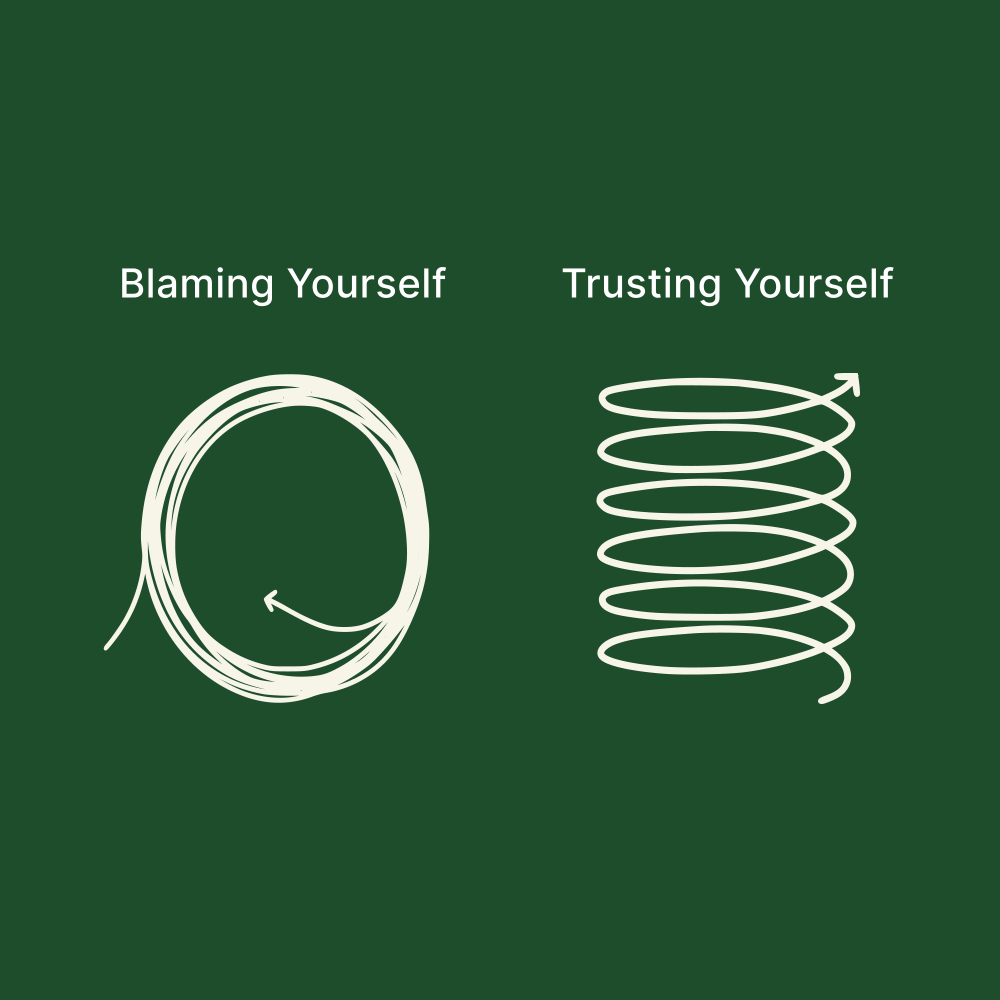
Self-criticism → Self-compassion
- There will never be anybody else in the world that can be as brutal to you as you can to yourself. You’re your worst enemy.
- We tend to be our own biggest critic.
- Next time you find yourself wanting to criticize yourself for not being great, ask if you can instead celebrate being good enough.
- Savor the little victories as much as you criticize the little mistakes. You can focus on the small loses, or you can celebrate the small wins.
Legendary UCLA basketball coach John Wooden recommended the following nine promises that should be made by anyone seeking happiness and success…
- Promise yourself that you will talk health, happiness, and prosperity as often as possible.
- Promise yourself to make all your friends know there is something in them that is special and that you value.
- Promise yourself to think only of the best, to work only for the best, and to expect only the best in yourself and others.
- Promise yourself to be just as enthusiastic about the success of others as you are about your own.
- Promise yourself to wear a cheerful appearance at all times and give every person you meet a smile.
- Promise yourself to be so strong that nothing can disturb your peace of mind.
- Promise yourself to forget the mistakes of the past and press on to greater achievements in the future.
- Promise yourself to give so much time to improving yourself that you have no time to criticize others.
- Promise yourself to be too large for worry, too noble for anger, too strong for fear, and too happy to permit trouble to press on you.
– John Wooden, Wooden: A Lifetime of Observations and Reflections On and Off the Court
[@kleckPerceptionsImpactNegatively1980]
Victim Mentality: The 1980 Dartmouth Scar Experiment(傷痕實驗)
[@gottliebMaybeYouShould2019]
In Maybe You Should Talk to Someone, Lori Gottlieb frames guilt in a way I hadn’t considered before:
The “self-imposed sentences” we give ourselves.
When we feel guilty about something we’ve done, we often subconsciously decide how long we “should” suffer as a form of self-punishment.
Instead of forgiving ourselves or moving forward, we assign ourselves a kind of invisible prison sentence:
- “Because I hurt someone, I must feel guilty for the rest of my life.”
- “Because I made a mistake, I have to keep paying for it.”
#Newsletter
You ever notice when you take a wrong turn on Google Maps, it doesn’t scream at you? It doesn’t say, you idiot, you failed. It just says recalculating and gives you another route.
That’s business. That’s life. You mess up, cool—reroute.
Maybe that wrong turn saves you from a worse crash. Maybe that detour taught you what the straight path never could. Maybe that scenic route was the exact view you needed to keep going.
So stop yelling at yourself like you lost forever. You’re not behind. You’re just recalculating.
And guess what? You’re still going to get there.
Dr. Peter Attia (Author of Outlive) shared a method on the Modern Wisdom podcast that he says completely fixed his negative self talk:
- Notice when you’re about to speak to yourself negatively.
- Rather than engaging with it, pull out your phone and record a voice memo of what you would say to a friend if they had just made the same mistake as you.
Your identity dictates your actions
A true transformation begins with a mental shift
Acceptance and Commitment Therapy
Footnotes
-
Or: “I will try.”, “I need help.” ↩